We have described lines and planes using linear equations. What happens when we require a point to satisfy several equations at once? Geometrically, we are looking for the intersection of the corresponding lines or planes.
We’ll begin with two equations in two variables, then use lines and planes to explore larger systems. Finally, we’ll see why engineering problems can require thousands of equations and why we need a way to solve systems without drawing them.
Linear equations and their solutions
A linear equation in the variables has the form
where the coefficients and the right-hand side are fixed numbers. The variables appear only to the first power, and we do not multiply variables together. For example, is linear, while and are not.
The number of equations need not equal the number of variables. Three equations in and still describe points in ; three equations in , , and describe points in .
For our geometric examples, each equation has at least one nonzero variable coefficient. Thus, an equation in two variables describes a line, and an equation in three variables describes a plane.
Two equations in two variables
Consider
Each equation describes a line. A solution belongs to both lines, so the solution set is their intersection. There are three possibilities.
| Arrangement | Common solution set | Number of solutions |
|---|---|---|
| Two lines intersect at one point | A point | One |
| Two distinct parallel lines | The empty set | None |
| Two coincident lines | The entire line | Infinitely many |
Coincident means that the two equations describe the same line, even if the equations look different.
Two lines that cross at a point have a transverse intersection. They need not be perpendicular. If we choose two lines at random, this is the typical situation: being parallel or coincident requires a special relationship between their directions.
Here, choosing equations at random means making independent, continuous choices of coefficients, without restrictions such as requiring every equation to be homogeneous.
Example: One solution
Consider the system:
The first equation forces , and the second then forces . The only solution is , where the lines intersect.
Example: No solutions
No point can have both and . These are distinct parallel lines, so their intersection is empty.
Example: Infinitely many solutions
The second equation is twice the first, so it adds no new restriction. Both describe . The solution set is
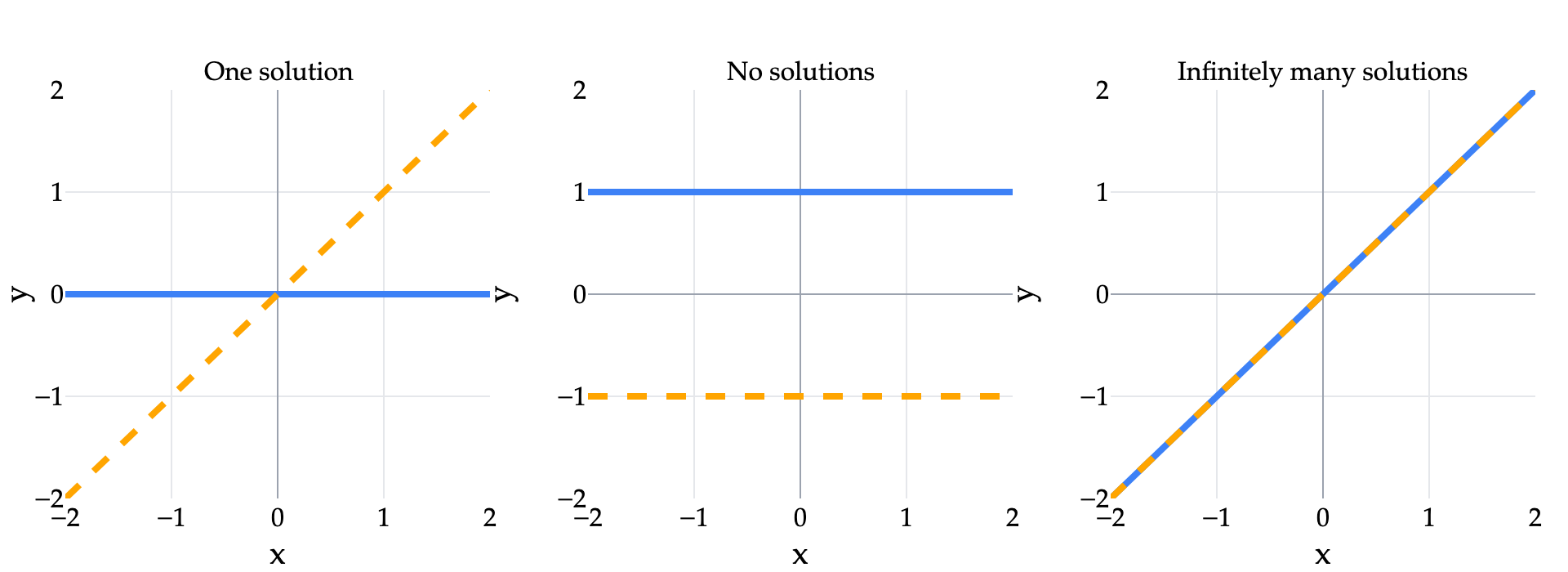
Two lines can share one point, no points, or every point on a line. In the last panel, the dashed orange line lies on top of the blue line.
More equations and homogeneous systems
Adding an equation means keeping only the points that also satisfy that equation. It can shrink the solution set or leave it unchanged; it can never add new solutions.
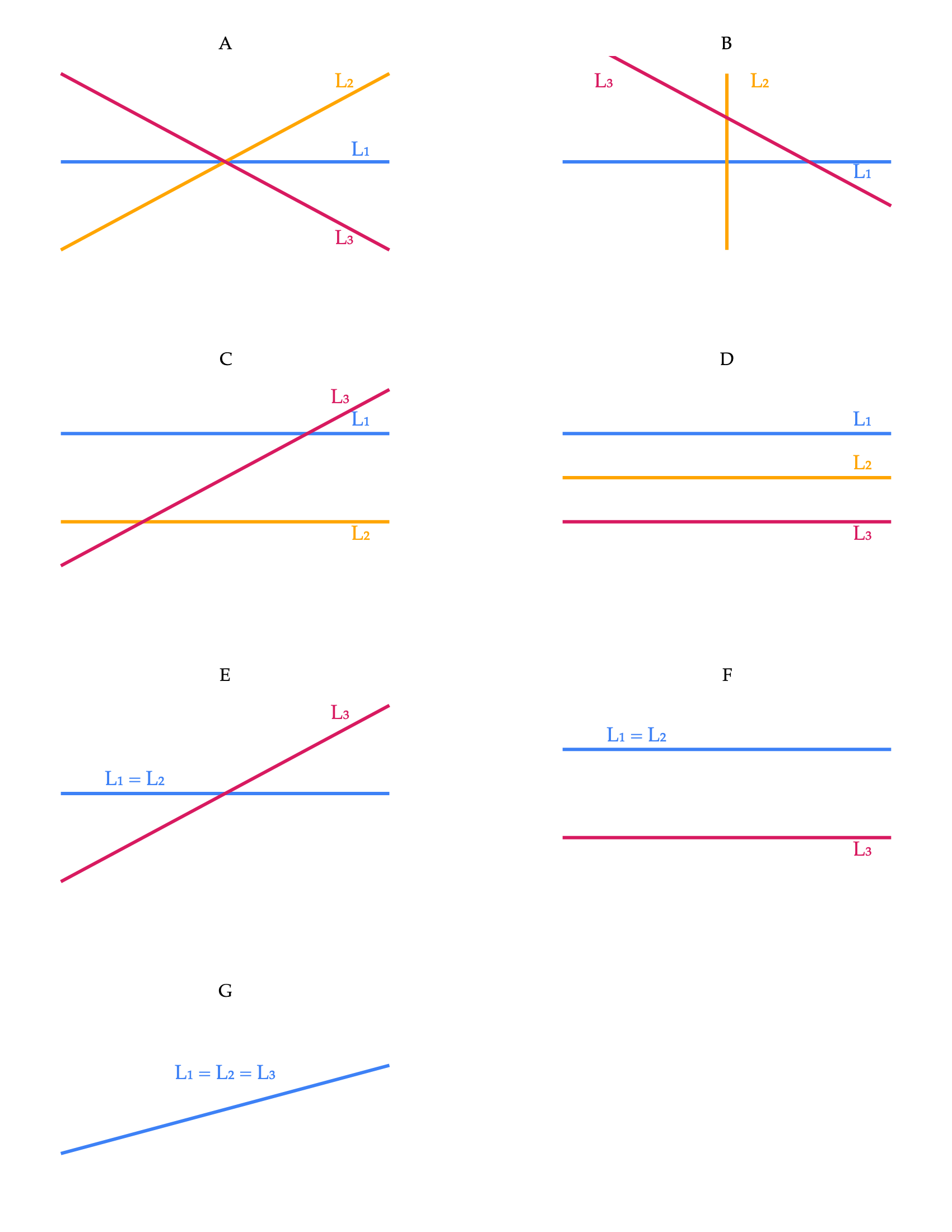
For example, and meet at the origin. Adding leaves no common solution. Each pair of lines intersects, but the three lines do not share a point. A solution of a system must satisfy all of its equations, not just some pair.
This is also the typical arrangement of three randomly chosen lines in : each pair intersects transversely, but the three intersection points form a triangle. The first two lines determine a point; the third line generally misses that point. Thus, the system typically has no solutions, even though every pair of equations has a solution.
Every homogeneous system has the zero solution, obtained by setting all variables to zero. Geometrically, all its lines or planes pass through the origin. A homogeneous system can therefore never have an empty solution set.
The converse needs care: a system can have solutions without being homogeneous. For instance, , has the solution , but it is not homogeneous in these coordinates.
Three equations in three variables
In , each equation describes a plane when its normal vector is nonzero. A solution of a three-equation system is a point that lies on all three planes.
There are eight possible arrangements of three planes. How can we find them all without guessing? Start with two planes, then add the third.
First, consider two planes
Imagine two sheets of paper extending forever in every direction. There are three possibilities:
The planes coincide: they are the same plane.
Two coincident planes share an entire plane. Drag to rotate. Colored patches represent portions of infinite planes.
The planes are parallel and distinct: they never meet.
Two distinct parallel planes have no common points. Drag to rotate. Colored patches represent portions of infinite planes.
The planes intersect in a line.
Two distinct nonparallel planes share the dark line L. Drag to rotate. Colored patches represent portions of infinite planes.
Two distinct planes cannot meet at just one point. If two sheets of paper cross, their intersection extends along a line.
Now call our three planes , , and . We will use these three starting possibilities to organize the discussion. Changing the names of the planes does not give a new arrangement, so we will handle repeated planes first, then parallel pairs, then the remaining cases.
Two planes coincide: three possibilities
Suppose and are the same plane. Requiring a point to lie on both adds no restriction beyond requiring it to lie on that one plane. Adding is therefore just another two-plane problem:
Case 1: All three planes coincide. Every point on the shared plane satisfies all three equations. The solution set is a plane, so there are infinitely many solutions.
Case 1: All three planes coincide; the common intersection is the whole plane. Drag to rotate. Colored patches represent portions of infinite planes.
Case 2: The third plane is parallel to the shared plane and distinct from it. There is no point on both, so the system has no solutions.
Case 2: Two planes coincide and the third is parallel and distinct; there is no common point. Drag to rotate. Colored patches represent portions of infinite planes.
Case 3: The third plane intersects the shared plane. Their intersection is a line. Every point on that line lies on all three planes, so there are infinitely many solutions.
Case 3: Two planes coincide and the third cuts them along the dark common line. Drag to rotate. Colored patches represent portions of infinite planes.
For example, start with and . Choosing to be , , or produces these three possibilities, respectively.
Two distinct planes are parallel: two new possibilities
Now suppose all three planes are distinct, and two of them are parallel. Name that pair and . We have already handled any arrangement with repeated planes, so cannot coincide with either one.
Case 4: The third plane is parallel to both. We have three distinct parallel planes, like three separate sheets of paper stacked above one another.
Case 4: Three distinct parallel planes have no common point. Drag to rotate. Colored patches represent portions of infinite planes.
Case 5: The third plane cuts both. It meets along one line and along another. These two lines are distinct and parallel within .
Case 5: The third plane cuts a parallel pair along two different dashed lines; no point lies on all three planes. Drag to rotate. Colored patches represent portions of infinite planes.
For example, start with and . Choosing gives the first arrangement; choosing gives the second. A plane that cuts one of two parallel planes must cut the other, since the original planes have the same normal direction.
Both arrangements have no solutions. There is no point on both and , so adding a third plane cannot create a point shared by all three. In particular, the two intersection lines in the second arrangement are pairwise intersections, not solutions of the whole system.
We have now found five arrangements. There are three left.
Two planes intersect in a line: three remaining possibilities
For the remaining arrangements, all three planes are distinct and no two are parallel. The first two planes meet along a line; call it .
Every solution must already lie on . Thus, instead of trying to picture three planes at once, ask: How can the line meet the third plane?
Case 6: The entire line lies on . Think of three pages of a book meeting along its spine. All three planes share the same line, so there are infinitely many solutions. For example, , , and all contain the -axis.
Case 6: Three distinct planes meet along the same dark line, like pages meeting along a book spine. Drag to rotate. Colored patches represent portions of infinite planes.
Case 8: The line crosses at one point. That point is the only point on all three planes, so the system has exactly one solution. For example, the -plane and the -plane meet along the -axis. The -plane meets that axis only at the origin. Thus, the three coordinate planes share just the origin.
This is the typical arrangement of three randomly chosen planes in . The first two planes intersect in a line, and the third plane generally crosses that line at one point. This crossing is transverse, and the system has exactly one solution. Containing the entire line or being parallel to it requires a special alignment.
Case 8: The coordinate planes meet at the dark point; the dashed lines are their pairwise intersections. Drag to rotate. Colored patches represent portions of infinite planes.
Case 7: The line is parallel to and does not lie on it. No point on belongs to , so the system has no solutions. For example, and meet along the -axis, but no point on that axis satisfies . Each pair of planes still intersects in a line, yet there is no point shared by all three.
Case 7: Every pair intersects along a different dashed line, but no point lies on all three planes. Drag to rotate. Colored patches represent portions of infinite planes.
These are the only ways a line and a plane can meet. We have therefore found all arrangements, without counting any arrangement twice. The common solution set can be a plane, a line, a single point, or empty.
Summary of the eight configurations
In each row, the equations are listed in the order .
| Case | Configuration | Equations | Common intersection |
|---|---|---|---|
| 1 | All three coincide | ; ; | The plane ; infinitely many solutions |
| 2 | Two coincide; the third is parallel and distinct | ; ; | Empty |
| 3 | Two coincide; the third intersects them | ; ; | The -axis; infinitely many solutions |
| 4 | Three distinct parallel planes | ; ; | Empty |
| 5 | Exactly two are parallel; the third cuts both | ; ; | Empty |
| 6 | Three distinct planes share a line | ; ; | The -axis; infinitely many solutions |
| 7 | Every pair intersects, but all three have no common point | ; ; | Empty |
| 8 | Three planes meet at exactly one point | ; ; | The origin; one solution |
For the pairwise intersections: coincident planes intersect in the entire plane, and distinct parallel planes have empty intersection. In case 3, the third plane meets each of the coincident planes in the same line. In case 5, the third plane meets the parallel pair in two distinct parallel lines. In case 6, all three pairwise intersections are the same line. In case 7, they are the three parallel lines
In case 8, they are the three coordinate axes, which meet at the origin.
Cases 1, 3, 6, and 8 can represent homogeneous systems. They have a common point where we can place the origin; the numerical examples above are already homogeneous. The remaining configurations have no common point.
Completeness: if two planes coincide, we obtain cases 1–3. If all three are distinct and there is a parallel pair, we obtain cases 4–5. Otherwise, and meet along a line . The third plane contains (case 6), crosses it at one point (case 8), or misses it (case 7). These branches give arrangements.
Case 7 shows that pairwise intersection does not guarantee a common solution.
Worked examples
The following examples use the same idea with less immediate equations: find the line shared by two planes, then determine which points on that line lie on the third plane.
Example: Three planes sharing a line
Consider
The first two planes have normals and , which are not multiples. They meet in a line. The point lies on both planes, and is perpendicular to both normals. Thus, their intersection is
The third equation is twice the first minus the second, including the right-hand side:
Every point on that line therefore satisfies the third equation too. The solution set is the entire line, so there are infinitely many solutions.
Example: Every pair intersects, but there is no common solution
Change just the last right-hand side:
Any solution of the first two equations must satisfy , so it cannot also satisfy the third. There are no solutions, even though every pair of planes intersects. Their pairwise intersection lines are distinct and parallel.
Example: Exactly one solution
Instead, replace the third equation by :
Every solution must lie on the line from the first example, so substitute , , and into the third equation:
or . This forces , giving the unique solution .
Choose one of the three examples, then drag to rotate the planes. The dark line is the intersection of the first two planes; a dark point marks the unique solution in the last example. The colored patches show only part of each infinite plane.
Why engineering problems have so many unknowns
The same idea of satisfying several constraints at once appears in heat flow, circuits, and structures. The main difference is the number of variables.
Temperatures inside a chip
Suppose we model a chip using nine interior grid points. The temperatures along the boundary are known, while the interior temperatures are unknown. The table shows their positions; the boundary values are illustrative temperatures in degrees Celsius after temperatures have settled.
| 40 | 45 | 50 | ||
| 35 | 55 | |||
| 40 | 60 | |||
| 45 | 65 | |||
| 45 | 50 | 55 |
In this simplified model, heat leaving each interior region balances the heat generated there. The resulting equation says that four times its temperature equals the sum of its four neighboring temperatures plus a source term of 8.
The neighbors of have temperatures 40, 35, , and , so
or
The 8 is the heat-generation contribution after the model’s constants have been combined; it is not a fifth neighboring temperature. Applying the same balance at every interior grid point gives
There are nine equations in nine unknowns. We need temperatures that satisfy all nine equations simultaneously; changing one temperature affects several balances.
A finer grid estimates temperatures at more locations:
| Interior grid | Unknown temperatures | Linear equations |
|---|---|---|
| 9 | 9 | |
| 100 | 100 | |
| 10,000 | 10,000 |
Voltages in a resistor network
Now consider a circuit with six unknown junction voltages . A supply holds the left rail at 12 volts and the right rail at 0 volts. At every junction, current entering equals current leaving.
At junction , a resistor connects to the 12-volt rail, a resistor connects to , and a resistor connects to . Ohm’s law gives current as voltage difference divided by resistance, so
Multiplying by 6 and collecting terms gives
Writing the corresponding balance at each junction in the network gives
Each unknown voltage appears in several equations because neighboring junctions are connected. A network with 5,000 unknown junction voltages similarly gives 5,000 current-balance equations.
Bridges and aircraft wings
For a structural model, the unknowns can be displacements. A model with 10,000 freely moving points in three-dimensional space has 30,000 unknown displacement components: one in each coordinate direction at each point. For small deformations, a linear model relates these displacements to the applied forces.
Next: Organizing systems using matrices
Geometry tells us what a solution means: it must satisfy every equation at once. It also helps us understand why a system may have no solutions, one solution, or infinitely many.
But we cannot solve a system with thousands of variables by drawing its solution set. We need algebraic methods that organize the coefficients and operate on the equations systematically.
Next time, we’ll introduce matrices, which give us a compact way to organize linear systems and a starting point for methods that work far beyond two or three variables.