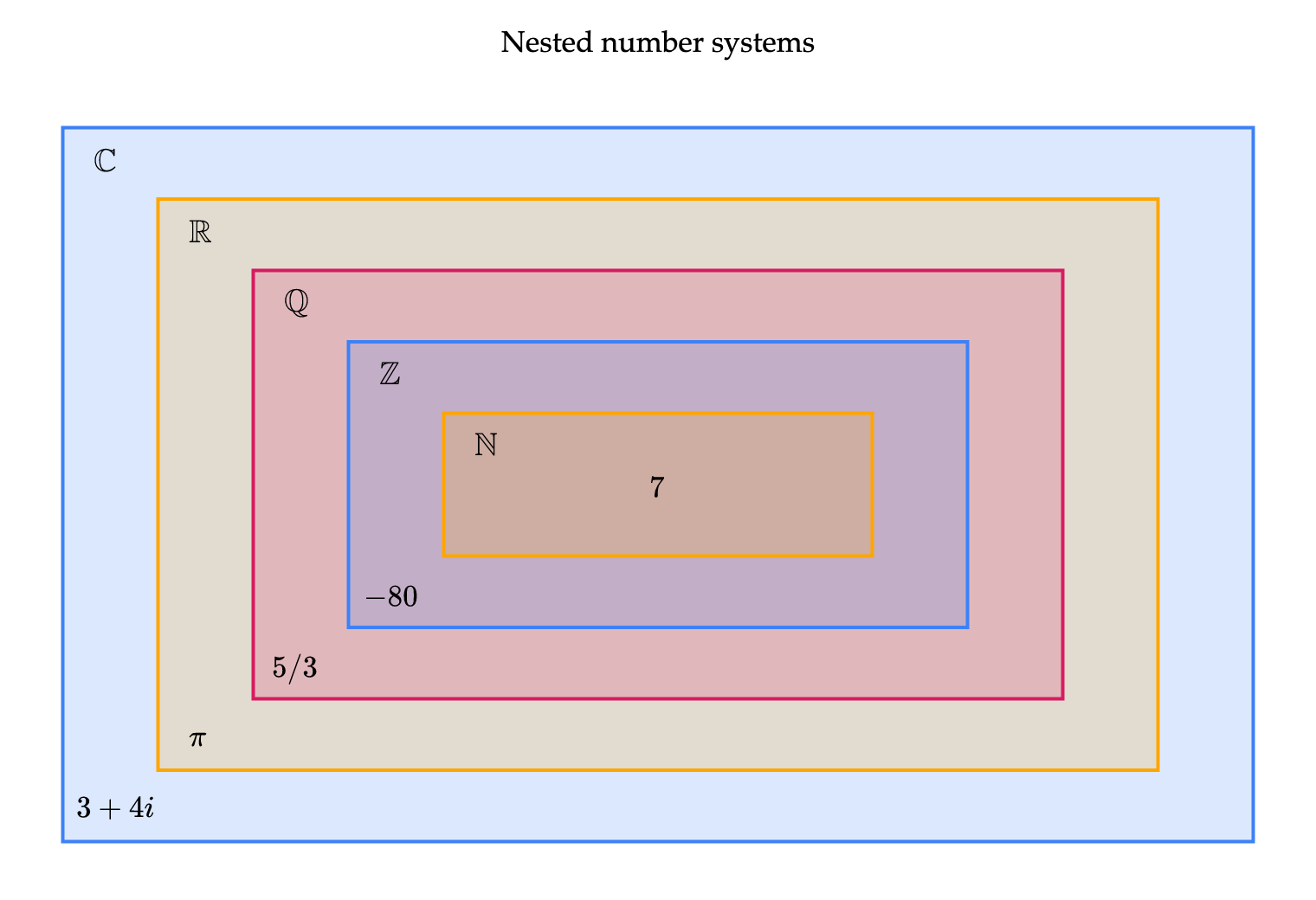
In Chapter 1.2, we covered the set-builder notation for sets, and introduced the set of integers, Z, and real numbers, R. Here, we’ll discuss these sets, and other sets of numbers, in more detail. In this course, we’ll almost always work with the set of real numbers, but it’s important to understand how these sets are all related.
Let’s start with an activity to refresh our understanding of set-builder notation from Chapter 1.2.
Natural numberscount discrete objects. They answer questions that ask “how many”: how many students are in the class? How many vehicles crossed the bridge?
Here, we’ll use the convention
N={0,1,2,3,…}.
Thus 0∈N. Other sources sometimes begin the natural numbers at 1, and say the whole numbers are the natural numbers including 0.
The rational numbers are the numbers that can be written as a ratio of integers. The set of rationals is best described using set-builder notation, since it’s difficult to enumerate them:
Q={qp:p,q∈Z,q=0}.
Every integer is rational: for example, −3=−3/1. Terminating and repeating decimals are rational too. This means that Z⊆Q (and so N⊆Q as well).
The real numbers are all the numbers on the usual number line. They include all of the rational numbers, and also include the set of irrational numbers, which includes numbers like 2 and −π. Irrational numbers are those that cannot be written as a ratio of integers.
Real numbers are useful for modeling physical quantities such as distance, time, and temperature. More on this idea of the real numbers as the number line in a moment. The key idea is that most numbers you’ve seen before – 2,31,2026,−94.5313413, and so on – are real numbers.
Real numbers are not the end of the story. Enter the complex numbers. A complex number is an expression of the form
a+bi,
where a and b are real numbers, and i is the imaginary unit, which satisfies
i2=−1.
Complex numbers allow us to extend the real numbers to a larger set of numbers that solves problems that cannot be solved using real numbers alone. For example, if asked to use the quadratic formula to find the roots of the quadratic equation
x2+5x+8=0,
you’d find that the solutions are
x=2−5±25−32=2−5±−7.
But, the square root of -7 is not a real number, because such a real number would have to satisfy x2=−7, and the squares of all real numbers are greater than or equal to 0.
7i is a number whose square is -7. Using the fact that i2=−1, we have:
(7i)2=(7)2⋅i2=7⋅(−1)=−7.
So, the solutions to x2+5x+8=0 are
x=2−5±7i.
Both 2−5+7i and 2−5−7i are complex numbers.
Complex numbers appear naturally in electrical engineering, signal processing, waves, and differential equations. You do not need to master them now. The important point is that linear algebra is not limited to real-valued quantities, even though real numbers will be our main focus. You will get more practice with complex numbers in various homework assignments in this course.
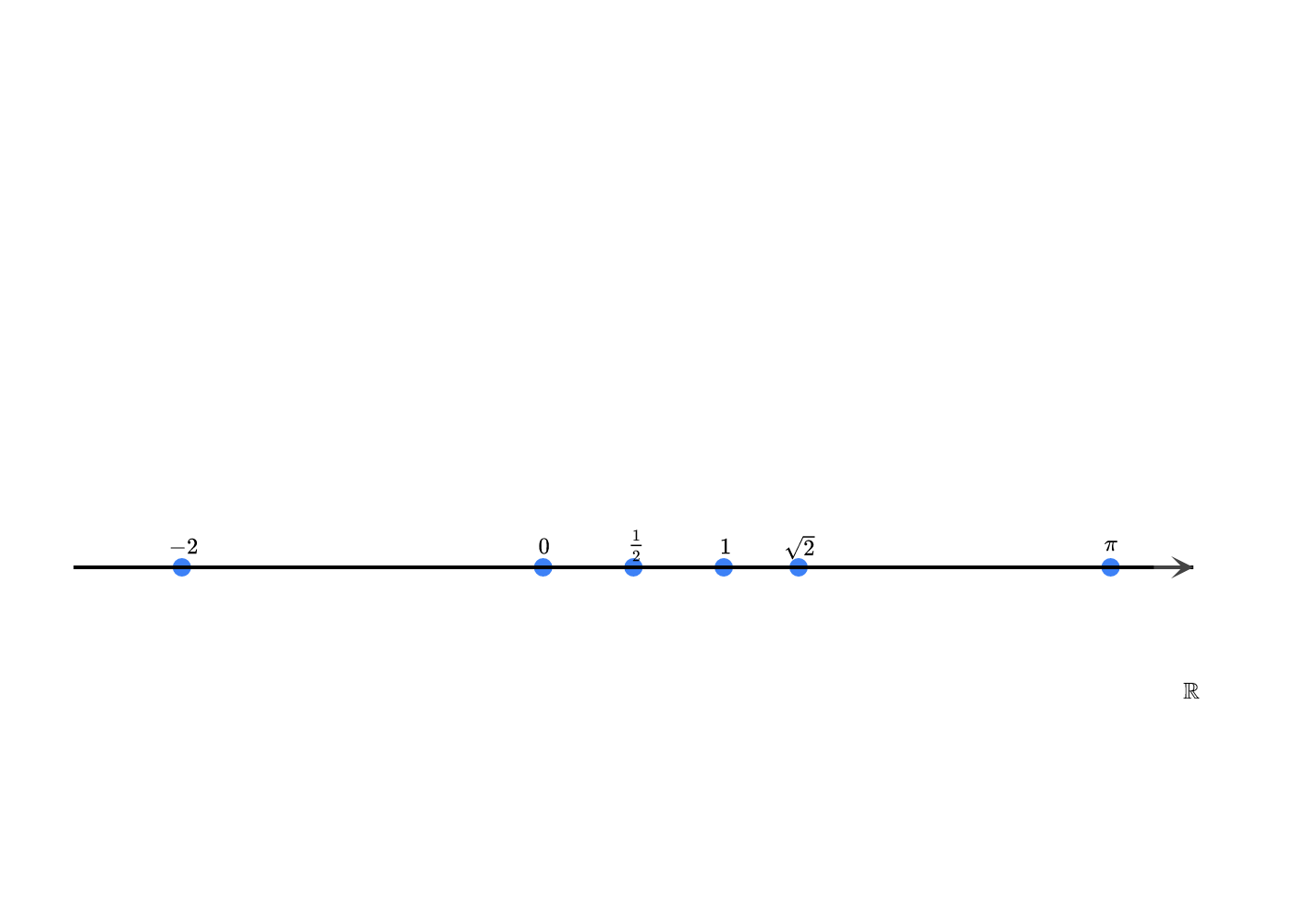
Back to the real numbers, which are our focus in this course. The real numbers R can be viewed geometrically as the real number line, where each real number corresponds to one point.
import math
import plotly.graph_objects as go
import plotly.io as pio

values = [-2, 0, 0.5, 1, math.sqrt(2), math.pi]
labels = [r"$-2$", r"$0$", r"$\frac{1}{2}$", r"$1$", r"$\sqrt{2}$", r"$\pi$"]

fig = go.Figure(go.Scatter(
    x=values, y=[0] * len(values), mode="markers+text",
    text=labels, textposition="top center", marker=dict(size=10), hovertemplate="%{x}<extra></extra>",
))
fig.add_shape(type="line", x0=-2.6, x1=3.6, y0=0, y1=0, line=dict(width=2))
fig.add_annotation(x=3.6, y=0, ax=3.35, ay=0, xref="x", yref="y", axref="x", ayref="y", showarrow=True, arrowhead=3)
fig.add_annotation(x=3.62, y=-0.12, text=r"$\mathbb{R}$", showarrow=False)
fig.update_layout(
    # title="Some points on the real line", width=800, height=260,
    showlegend=False, font_family="Palatino", margin=dict(l=30, r=30, t=55, b=25),
    xaxis=dict(range=[-2.7, 3.85], visible=False), yaxis=dict(range=[-0.3, 0.45], visible=False),
)
from pathlib import Path as _PlotPath
import sys as _plot_sys
_notes_root = next(path for path in [_PlotPath.cwd(), *_PlotPath.cwd().parents] if (path / "myst.yml").exists())
if str(_notes_root) not in _plot_sys.path:
    _plot_sys.path.insert(0, str(_notes_root))
from plot_style import style_plotly as _style_plotly

_style_plotly(fig, renderer="png")
fig.show(scale=2)
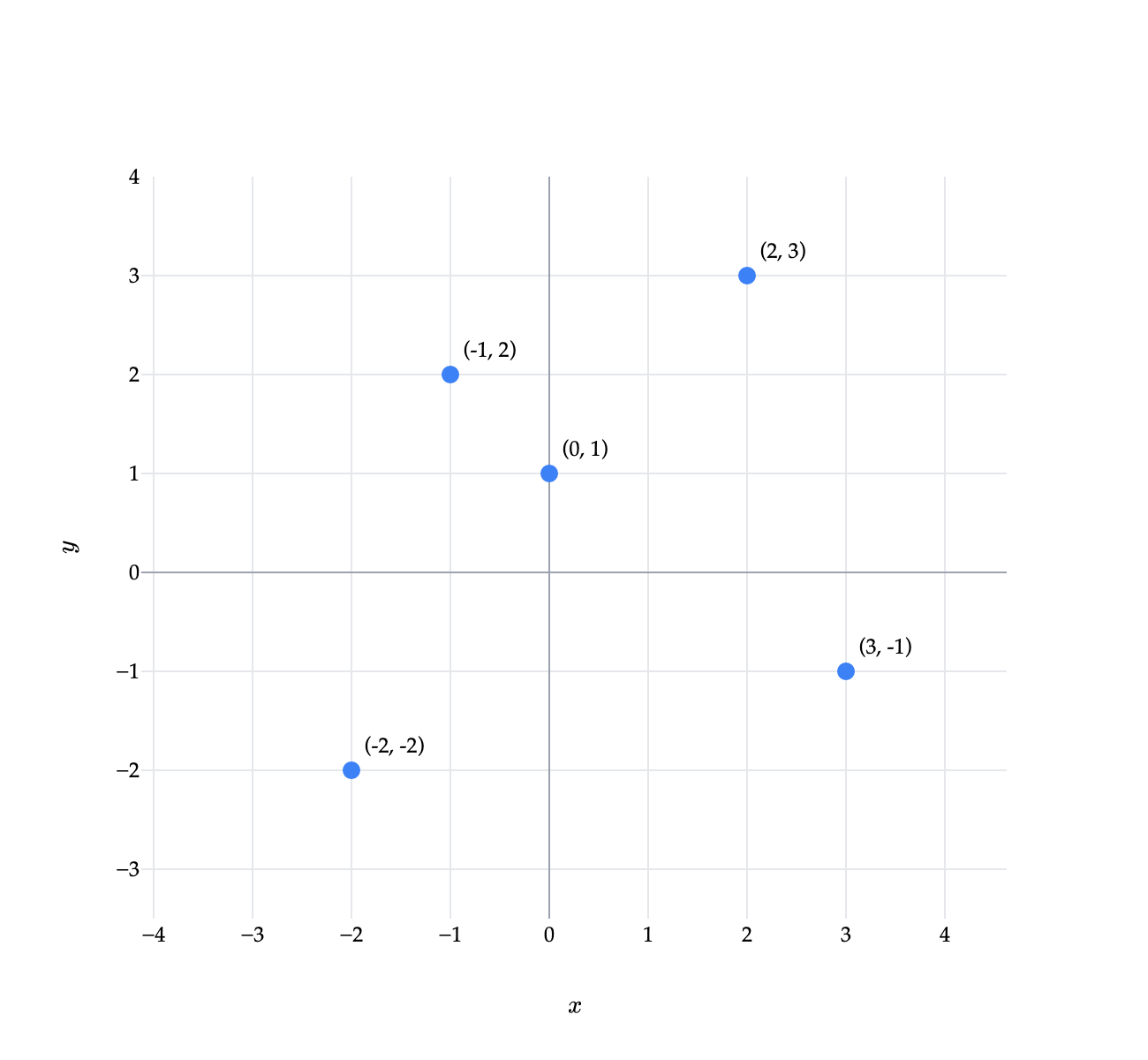
The space R2 – pronounced “R-two” – is the set of all ordered pairs of real numbers, resulting from the Cartesian product of R with itself:
R2=R×R.
In set-builder notation,
R2={(x,y):x∈R,y∈R}.
The exponent of 2 on R means that we are looking at pairs of real numbers.
Just as R can be thought of as the real number line, R2 can be thought of as the Euclidean plane. Its elements are points with an x-coordinate and a y-coordinate. The term Euclidean is named after Euclid, an ancient Greek mathematician who was a pivotal figure in geometry. The Euclidean plane obeys the familiar rules of plane geometry, including the Pythagorean theorem, which we will see once again shortly.
import plotly.graph_objects as go
import plotly.io as pio

points = [(2, 3), (-1, 2), (3, -1), (-2, -2), (0, 1)]
fig = go.Figure(go.Scatter(
    x=[p[0] for p in points], y=[p[1] for p in points], mode="markers+text",
    text=[f"({x}, {y})" for x, y in points], textposition="top right",
    marker=dict(size=10), hovertemplate="(%{x}, %{y})<extra></extra>",
))
fig.update_layout(
    width=650, height=600,
    xaxis_title="$x$", yaxis_title="$y$", showlegend=False, font_family="Palatino",
)
fig.update_xaxes(range=[-3.5, 4], dtick=1, zeroline=True, scaleanchor="y")
fig.update_yaxes(range=[-3.5, 4], dtick=1, zeroline=True)
from pathlib import Path as _PlotPath
import sys as _plot_sys
_notes_root = next(path for path in [_PlotPath.cwd(), *_PlotPath.cwd().parents] if (path / "myst.yml").exists())
if str(_notes_root) not in _plot_sys.path:
    _plot_sys.path.insert(0, str(_notes_root))
from plot_style import style_plotly as _style_plotly

_style_plotly(fig, renderer="png")
fig.show(scale=2)
The order of the two coordinates matters. The points (2,3) and (3,2) are different elements of R2. This is unlike sets, where order does not matter: {2,3}={3,2}.
R3 – pronounced “R-three” – is the set of all ordered triples of real numbers:
R3={(x,y,z):x,y,z∈R}.
Think of R3 as three-dimensional Euclidean space.
import plotly.graph_objects as go
import plotly.io as pio

points = [(1, 2, 3), (-2, 1, 2), (3, -1, 1), (-1, -2, -1), (0, 2, -2)]
fig = go.Figure(go.Scatter3d(
    x=[p[0] for p in points], y=[p[1] for p in points], z=[p[2] for p in points],
    mode="markers+text", text=[f"({x}, {y}, {z})" for x, y, z in points],
    textposition="top right", marker=dict(size=5),
    hovertemplate="(%{x}, %{y}, %{z})<extra></extra>",
))
axis = dict(range=[-3, 4], dtick=1)
fig.update_layout(
    width=720, height=620,
    title_text="Points in ℝ³",
    showlegend=False, font_family="Palatino",
    scene=dict(xaxis=axis, yaxis=axis, zaxis=axis, aspectmode="cube"),
)
from pathlib import Path as _PlotPath
import sys as _plot_sys
_notes_root = next(path for path in [_PlotPath.cwd(), *_PlotPath.cwd().parents] if (path / "myst.yml").exists())
if str(_notes_root) not in _plot_sys.path:
    _plot_sys.path.insert(0, str(_notes_root))
from plot_style import style_plotly as _style_plotly

_style_plotly(fig, renderer="plotly_mimetype")
fig.show()
We can generalize beyond two and three dimensions. The n-dimensional Euclidean space, again pronounced “R-n”, is the set of all ordered n-tuples of real numbers (assuming n is a positive integer):
Rn={(x1,…,xn):x1,…,xn∈R}.
(“Tuple” is a generalization of “pair” and “triple” for any number of entries.)
Equivalently, Rn is the Cartesian product of R with itself n times. The exponent on R tells us the number of real numbers each ordered tuple holds.
When might we want to work with elements of Rn? Often, in fact! Suppose we recorded 5 pieces of information for each student in Math 124:
Their age.
Their height.
Their shoe size.
Their number of siblings.
Their number of followers on Instagram.
Then, each student’s data can be represented as an ordered 5-tuple of real numbers, and we can represent them as elements of R5. We can’t visualize data in R5 directly, since as humans we’re limited to 3 dimensions. But, that’s the beauty of mathematics! We can define objects like 5-dimensional spaces algebraically, even though we can’t draw or picture them. This idea, of thinking in high dimensions, is one that we will return to throughout the course.
But for the remainder of Chapters 1 and 2, we will return our focus to R2 and R3, that is, the two- and three- dimensional Euclidean spaces. With that, we’re ready to finally introduce the concept of a vector! Keep reading for more.